


Accelerated Graduate Programs
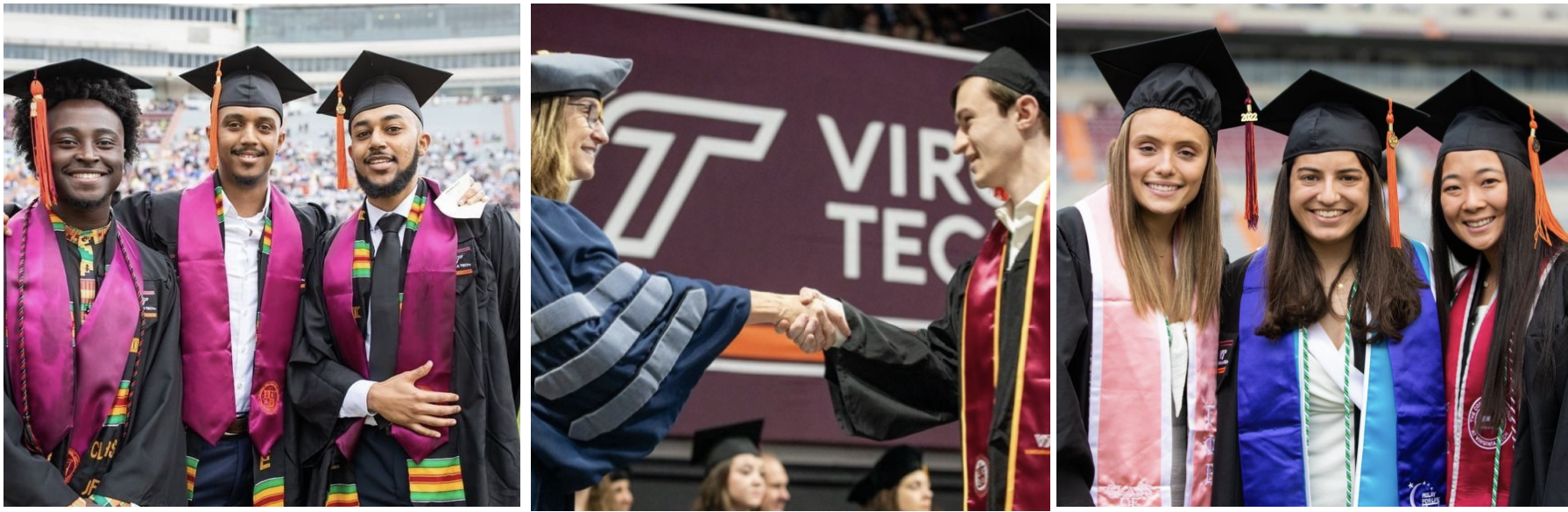
CS undergraduate students can earn both a bachelor's degree and a master's degree in computer science in less time than it would take to complete them separately. You do this by taking graduate courses during your undergraduate years that count toward both degrees at the same time.
There are two ways to do this — a 4+1 option and a 3+1 option. These aren't separate programs you're choosing between; they're just different timelines for the same program (and to be honest, there’s nothing special about those numbers — you can even do a 3.5+1 if that works better for you). The right timeline for you depends on how many credits you're bringing in when you start. Your advisor can help you figure out which makes sense for your situation.
In the 4+1 option: You complete your bachelor's degree in four years while taking some graduate courses along the way, then finish your master's degree in a fifth year.
The 3+1 option: You are a student entering Virginia Tech with a significant amount of AP, IB, or dual-enrollment credit -- roughly 19 or more credits that can count toward your degree. If that's you, it may be possible to complete your bachelor's degree in three years and your master's degree in a fourth. You don't need to have this figured out before you arrive. Talk to your advisor early, and they'll help you assess whether this timeline is realistic for you.
Within Computer Science, the accelerated program leads to either a Master of Engineering (M.Eng.) or a Master of Science (M.S.). The two degrees have different requirements and different eligibility thresholds.
Master of Engineering (M.Eng.)
- Requires 10 graduate courses; no thesis
- Minimum 3.30 GPA overall when applying to the program
- Must have completed CS 2114 or CS 3114 with a B- or better
- Application requires one (1) letter of recommendation (academic source preferred)
Master of Science (M.S.)
- Requires seven (7) graduate courses plus a thesis
- Minimum 3.30 GPA overall when applying to the program
- Must be a current CS major or a current CS minor
- Must have completed CS 3114 with a B- or better at time of application
- Application requires three (3) letters of recommendation, with at least one from a CS faculty member
For both degrees, you must have completed a minimum of 75 undergraduate credits before you can begin taking double-counted graduate courses.
Non-CS majors pursuing the M.S. are responsible for working with their home department advisor on any course substitutions needed when double-counting graduate courses in place of undergraduate requirements. CS majors and CS minors -- we handle those substitutions for you.
The main benefit of the accelerated program is double-counting: graduate courses you take during your senior year can count toward both your bachelor's degree requirements and your master's degree at the same time.
CS students in the program may take up to four graduate courses during their senior year in place of required CS 4000-level courses. A few things to know:
- No more than 12 credits total may be double-counted.
- You must earn a B or higher in any course you want to count toward your graduate degree.
- Courses must be taken for a grade. Courses numbered 5974, 5994, and 5944 do not count.
It's never too early to start thinking about this, even if you're not sure yet whether an accelerated program is right for you. A few things that will keep your options open:
Talk to your advisor from day one. Bring up the accelerated program at your very first advising meeting, and mention it again at every meeting after that. Your advisor can't help you plan for it if they don't know you're interested.
Take at least one CS course every semester. Staying on pace in the CS sequence is critical. That means CS 1114 your first semester (or CS 2114 if you already have credit for CS 1114), and CS 2104 whenever it fits. Falling behind in the sequence makes both timelines harder.
Take CS 1944 as soon as you're eligible. Once you have credit for CS 1114, you can enroll in CS 1944 -- a first-year seminar that connects you to the CS community and to resources you'll want to know about early. For many students, that means taking CS 1944 in their second semester, though if you expect to receive AP credit for CS 1114, you can register for it your first semester.
If you're considering the 3+1 option: Try to take ENGE 1414 (Foundations of Engineering) in your first semester rather than splitting ENGE 1215 and ENGE 1216 across two semesters. Taking ENGE 1414 lets you declare the CS major sooner, which opens up more options. ENGE 1414 requires credit for both MATH 1225 and MATH 1226. If you expect to receive that credit from AP scores but don't have official results yet when registration opens, go ahead and register for ENGE 1414 to hold your spot -- you can always adjust later once your scores arrive.
The application process is managed through the Virginia Tech Graduate School. The Graduate School's accelerated program page walks through the full steps, including the required forms and how approval works.
The key deadline to know: you must be accepted into the program before the first day of the semester in which you want to start taking double-counted courses.
Your undergraduate advisor can assist with:
- Connecting you to resources to learn more about graduate program options.
- Explain how double-counted coursework may fit into your undergraduate academic plan.
- Communicate relevant application deadlines and processes.
- Review and sign the course designation form and re-sign it if updates are needed.
The following responsibilities fall outside the scope of undergraduate advising:
- Advocating for or influencing admission decisions.
- Enrolling students in graduate courses.
- Creating a graduate degree plan or selecting graduate coursework.
- Providing academic advising for the graduate program.
- Master of Engineering (M.Eng.): Rebecca Stevenson, rss03@vt.edu
- Master of Science (M.S.): Andrea Sirles, asirles@vt.edu